
An Enncrave compilation
General Douglas MacArthur
MacArthur’s Leyte landing a publicity stunt? This iconic photograph of General Douglas MacArthur wading ashore during the Leyte landing in October 1944 is controversial primarily because of its staged nature and the perception that it is a publicity stunt.
Here’s why:
1. The “Return” Narrative: MacArthur had famously declared, “I shall return” after being forced to evacuate the Philippines in 1942. His return to the Philippines was a highly anticipated and emotionally charged moment, both for him personally and for the American public. This landing was meant to symbolize the fulfillment of that promise.
2. The Actual Landing: While the photo depicts him wading through the surf, MacArthur’s party had actually arrived on Leyte earlier that day and established a beachhead. The famous “return” scene was reportedly orchestrated later for the cameras. He and his staff returned to the landing craft, sailed out a short distance, and then waded ashore to recreate the moment for the waiting photographers.
3. The Depth of the Water: Critics often point out that the water in the photograph appears relatively shallow, only reaching his knees. This fueled the perception that it was a carefully managed photo opportunity rather than a spontaneous, arduous “return.” While it was still a genuine landing on a newly secured beach during an active invasion, the visual was crafted.
4. MacArthur’s Persona and Public Image: MacArthur was a figure known for his strong ego and keen understanding of public relations. This photograph perfectly fit into his cultivated image as a heroic, larger-than-life leader. For some, it cemented his legendary status; for others, it highlighted his perceived vanity and theatricality.
So, while the event itself (MacArthur’s return to Leyte) was real and incredibly significant, the specific photographic moment is considered controversial because it was a deliberate recreation for dramatic effect and public consumption, rather than a candid shot of the initial, more chaotic landing.
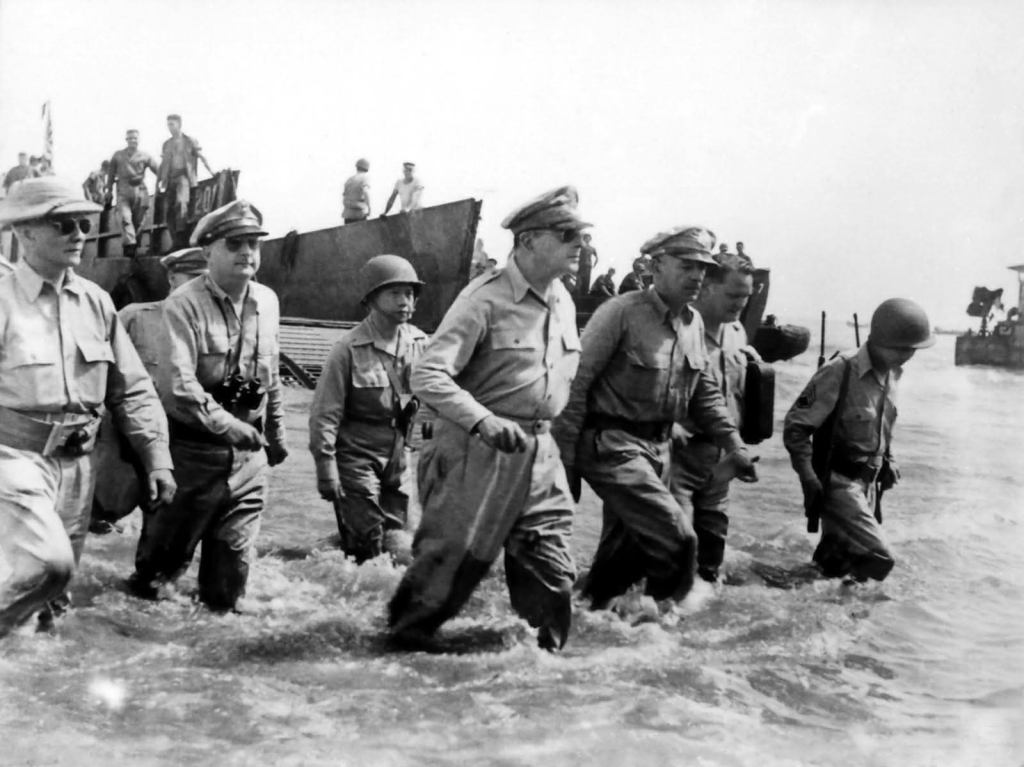
General MacArthur’s historic landing at Palo, Leyte, Philippines, on October 20, 1944, liberated the Philippines from Japanese occupation in World War II. The successful landing by the US and allied forces at Red Beach in Palo, Leyte, fulfilled MacArthur’s promise of “I shall return.”
Douglas MacArthur was an American five-star general and Field Marshal of the Philippine Army. He was Chief of Staff of the United States Army during the 1930s and played a prominent role in the Pacific theater during World War II.
https://www.youtube.com/@WARMEMORIES1
Discover the shocking truth about why President Harry Truman fired General Douglas MacArthur in 1951 – and how it all traced back to a catastrophic mistake Franklin Roosevelt made during World War II. Learn how Roosevelt let MacArthur become untouchable by tolerating years of insubordination, including the Leyte Gulf publicity stunt that endangered lives for a photo op. See how MacArthur’s ego spiraled out of control in Korea, leading to the Chinese disaster that cost the lives of thousands of American soldiers. Watch as Truman makes the most controversial decision in presidential history, firing America’s most beloved general despite knowing it would destroy his approval ratings. This is the untold story of how one president’s political cowardice created a monster, and how another president’s courage saved civilian control of the military. The Senate hearings that followed revealed the shocking truth about MacArthur’s insubordination – and vindicated Truman’s decision to put the Constitution above politics. https://www.youtube.com/@TheWW2Legacy
On April 11, 1951, President Harry Truman announced with “deep regret” that he had dismissed General Douglas MacArthur as commanding general of U.S. forces in the Korean War. Truman’s decision came after MacArthur repeatedly criticized the president’s policies, advocating a more aggressive strategy even as Truman sought to limit the war. After his announcement, the president faced intense criticism while MacArthur returned home to a hero’s welcome, including an address to a joint session of Congress and a ticker-tape parade through New York City in his honor. However, the controversy slowly subsided as most Americans–and U.S. generals–made it clear that they opposed MacArthur’s military strategy. General Omar Bradley famously said that MacArthur’s policies “would involve us in the wrong war, at the wrong place, at the wrong time, and with the wrong enemy.” James M. Lindsay, CFR’s senior vice president and director of studies, argues that the firing of MacArthur shows that “presidents can be justified in overruling the military advice of even their most decorated generals.” That lesson continues to apply today, he says. When President Obama receives recommendations from his generals concerning the war in Afghanistan, he “may accept those recommendations, revise them, or reject them entirely.” “That is the meaning of the principle of civilian control of the military,” Lindsay argues, “and it’s what the framers intended when they made the president ‘commander-in-chief.'” This video is part of Lessons Learned with James M. Lindsay, a series dedicated to exploring historical events and examining their meaning in the context of foreign relations today:https://www.youtube.com/@cfr cfr.org facebook.com/councilonforeignrelations x.com/CFR_org cfr.org/newsletters bsky.app/profile/cfr.org instagram.com/cfr_org tiktok.com/@cfr_org linkedin.com/companies/council-on-foreign-relations
Explore the shocking encounter between General MacArthur and Emperor Hirohito after Japan’s WWII surrender. Witness the humiliation of a god-like figure and the tense power dynamics that shaped post-war Japan. Discover how this meeting saved Hirohito’s life and changed the course of history.. Was it justice or a necessary evil for rebuilding a nation?. Find out the details of the meeting and the controversy surrounding MacArthur’s decision.
————————————————
Princes of the Yen reveals how post-war Japanese society was transformed to suit the agenda of powerful interest groups, and how citizens were kept entirely in the dark about this. History is now repeating itself around the world. Based on a book by Professor Richard Werner, a visiting researcher at the Bank of Japan during the 90s crash, during which the stock market dropped by 80% and house prices by up to 84%. The film uncovers how the Bank of Japan pumped up and then crashed the Japanese economy, with an aim of inducing change. Today, what happened in Japan 25 years ago is repeating itself in Europe, with an aim of centralising power in the Eurozone. The film shows why it is important for central banks to be accountable and transparent. It also explains how International Financial Organisations such as the IMF seek to impose conditions on countries that are mainly of benefit to dominant Western interests. For anyone interested in understanding recent developments and the significance of the establishment of institutions such as the AIIB and the BRICS led New Development Bank, Princes of the Yen provides the background. Princes of the Yen reveals with clarity the control levers that underpin the dominant ideology of the 21st Century. Piece by piece, reality is deconstructed to reveal the world as it is, not as those in power would like us to believe that it is.
https://www.youtube.com/@TimelineChannel
The Battle of Leyte Gulf (October 23–26, 1944) was the largest naval battle of World War II and a turning point in the Pacific. As U.S. forces landed in the Philippines to liberate the islands, Japan launched a desperate, all-out naval counterattack. Over four days of intense combat — from the sinking of the super battleship Musashi in the Sibuyan Sea, to the night clash at Surigao Strait, and the heroic stand of the small U.S. escort carriers at Samar — the Japanese fleet suffered catastrophic losses, including four carriers, three battleships, and numerous cruisers and destroyers. The defeat shattered Japan’s naval power and opened the road for the Allied liberation of the Philippines
 Life's Chronicle