
an Enncrave compilation
An Italian teenager who liked playing video games and making funny films of his pets became the Catholic Church’s first “millennial” saint on Sunday. Carlo Acutis, who was just 15 when he died from leukaemia in 2006, used his computing skills to spread awareness of the Catholic faith, setting up a website documenting reports of miracles. Nicknamed “God’s influencer,” he is seen as a pioneer of the church’s evangelizing efforts in the digital world.
Friar John longs for God, but his jealous Carmelite brothers resent his holiness and imprison him in a tiny cell, where he writes his beautiful “Spiritual Canticle.” The tension heightens – will he escape? The true story of Spain’s greatest poet.
The History of Little Margaret of Castello
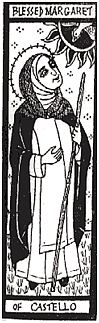
Saint Margaret of Castello was born into a well-to-do family near Florence, Italy in 1287. To the great distress of her parents, upon her birth, they discovered that she suffered from a variety of severe physical ailments. She was a dwarf, had a curved spine that left her hunched over, was lame to the point that she could barely walk, and was blind.
Her family was embarrassed by her and kept her hidden away for many years. As young as age 6, she was walled up in a room beside a chapel. A family chaplain taught her about God. Seeking a miracle, her parents took her to a Franciscan shrine. They didn’t receive one and abandoned her. Some in the community took pity on her and gave her the help she needed to survive. She became a member of the Dominican Third Order of Castello, developed a deep prayer life, and devoted the remainder of her 33-year life to performing acts of penance and charity.
Despite her suffering, Saint Margaret remained serene, calm, cheerful, and courageous. She never became bitter, complained, criticized others, or became discouraged. She went to mass daily and prayed fervently to Jesus, Mary, Joseph, and St. Dominic. St. Margaret accepted her suffering with the eyes of faith. She did not know why God allowed her to suffer from so many afflictions, yet she did know that He was all-good, did not allow evil without a good reason, and always turned evil into good for His children. She wondered why people pitied her; was it not a privilege to suffer with Christ? Suffering for her was her way to heaven.
One benefit of suffering was that it made her more sympathetic to the trials of others. She visited prisoners, helped the sick, and comforted the dying.
Saint Margaret has continued doing good in heaven. Since her death at age 33, she has continued to help those who pray to her. Many cures have since been attributed to her intercession. She is an inspiration to those who are discouraged and tempted to self-pity. Her intercession is most powerful to those who suffer from eye and muscular diseases. She has also become a patron for pro-life groups, and those who are unwanted and abandoned.
St. Margaret was declared Blessed in 1609. Her incorrupt body lies under the main altar of St. Dominic Church in Castello. Many visit her shrine there. She was canonized a saint, 701 years after her death, by Pope Francis on April 24, 2021.
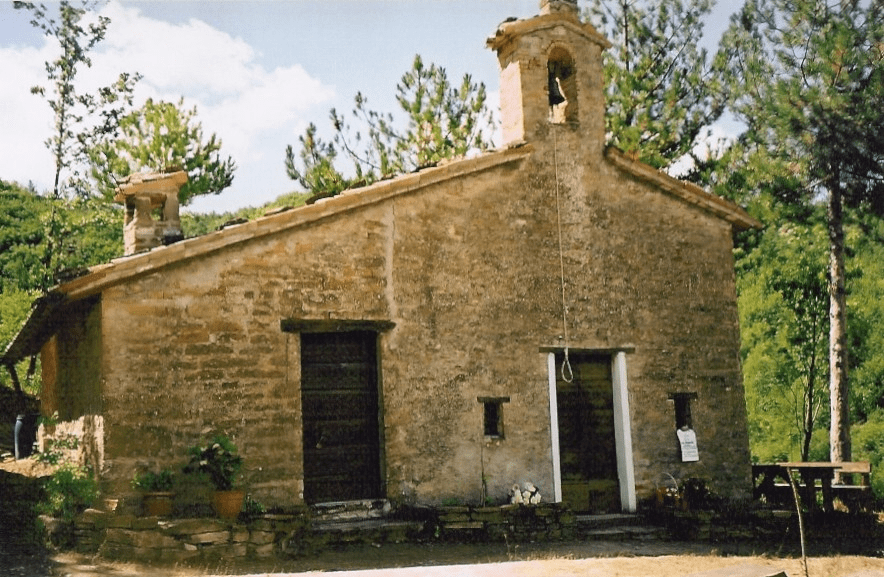
The room where Saint Margaret was held prisoner from the age of 6.
Rita of Cascia, born Margherita Lotti, was an Italian widow and Augustinian nun venerated as a saint in the Roman Catholic Church. After Rita’s husband died, she joined an Augustinian community of religious sisters, where she was known for practicing mortification of the flesh and for the efficacy of her prayers. Wikipedia
Pope John Paul II was head of the Catholic Church from 1978 until he died in 2005 and sovereign of the Vatican City State. He was later canonized as Pope Saint John Paul II. Wikipedia
Pio of Pietrelcina, generally known as Padre Pio, was an Italian Capuchin friar, priest, stigmatist, and mystic. He is venerated as a saint in the Catholic Church, celebrated on 23 September. Pio joined the Capuchins at fifteen and spent most of his religious life in the convent of San Giovanni Rotondo. https://en.wikipedia.org/wiki/Padre_Pio
Cascia, 14th century, Rita Liotti falls in love, gets married and has two children. Her dream of love is soon hindered by a masculine and violent society, that Rita faces with peace and forgiveness
Top 11 Incorrupted Bodies Of Saints Of The Catholic Church. The veneration of incorrupt bodies is a significant aspect of the Catholic Church, captivating both the devout and the curious. These phenomena involve the mortal remains of saints resisting decay and maintaining a lifelike appearance, serving as tangible reminders of holiness and divine intervention. Incorruptible bodies, such as those of Saint Bernadette Soubirous in Lourdes and Saint Catherine Labouré in Paris, inspire awe and deep spiritual contemplation. Exploring the mysteries surrounding these saints’ bodies sheds light on the enduring power of faith and encourages reflection on the intersection of the physical and the divine. Join us as we delve into the fascinating world of eleven incorruptible bodies within the Catholic Church..
 Life's Chronicle